

Every social brief eventually contains a sentence along the lines of:
“We need to communicate that our new product makes life easier.”
From there, the sentence has a habit of becoming the content. It appears on visuals, gets worked into a creator script, shows up in the caption, and somehow survives several rounds of feedback almost unchanged.
Brands spend a huge amount of time deciding what they want people to know. Positioning gets debated, claims get approved, and product benefits get carefully worded. Then social gets handed the finished message and is expected to turn it into something people want to watch.
That is where a lot of branded content starts to struggle, because the message and the social idea are doing different jobs.
The message tells people what you want them to remember. The social idea gives them a reason to pay attention long enough to remember it.
Everyone is trying to deliver something to you
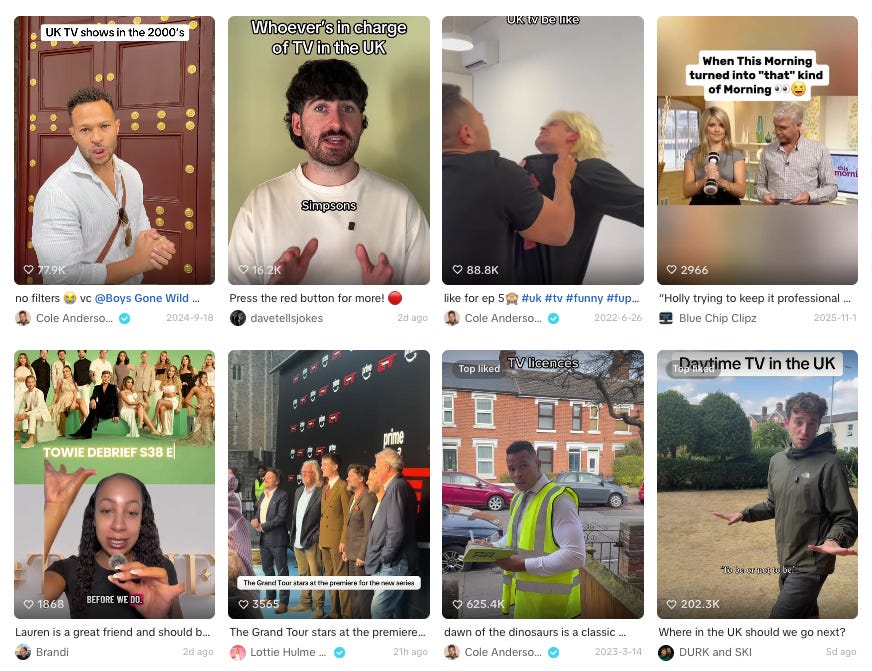
Think about your TikTok feed.
Someone is explaining what happened on Love Island.
Someone has a story about the worst date of their life.
A creator has found an unexpectedly good £12 foundation.
Your friend has sent you a dog falling off a sofa.
Then a brand arrives to announce its latest product. That is the environment branded content has to compete within.
Sprout Social’s 2025 Content Benchmarks Report analysed more than three billion messages from over one million public social profiles and described social content saturation as being at an all-time high. Brands published an average of 9.5 posts per day across networks in 2024, while some consumer-facing categories posted considerably more. Sprout Social
There is a huge amount of content being delivered into feeds every day. Publishing the message gives it a place in that pile. Packaging it as an interesting social idea gives it a chance of earning attention.
I find it useful to visualise this like a delivery:
The message is the package. The creative idea is the vehicle.
Your package might contain something genuinely valuable.
Your shoe is lighter.
Your banking app helps people understand their spending.
Your hotel has an incredible view.
Your meal kit saves people time.
The next question is how you get that information into someone’s feed in a form they actually want to receive.
A product message gives you the destination, rather than the journey
Many social briefs move directly from a product truth into an execution.
“Our app helps people save money” becomes a video explaining how the app helps people save money.
“Our hotel has incredible views” becomes a Reel of the view.
“Our seasoning improves flavour” becomes a recipe using the seasoning.
All perfectly logical. They also leave a lot of creative territory untouched.
The idea usually appears when you ask what people could experience around the message.
“Our app helps people save money” could become showing someone every bit of cashback they missed during the past month.
“Our shoe is incredibly lightweight” could become weighing increasingly ridiculous objects against it.
“Our seasoning improves flavour” could become putting badly seasoned meals on trial for crimes against food.
“Our hotel has incredible views” could become ranking the strangest things guests have spotted from the rooftop.
The product truth stays intact. The delivery changes.
That distinction is becoming more important as people expect stronger ideas from brands.
The 2025 Sprout Social Index surveyed more than 4,000 consumers and found that 46% say their favourite brands stand out by publishing original content. Sprout’s 2026 research found that only 56% of social users think brands currently do a good job of producing truly original content. Sprout Social
Brands are producing a lot. Audiences still see room for more originality. I think part of that gap lies in how social content gets briefed.
1. Get clear on what needs to arrive
Before thinking about formats, define the takeaway.
Imagine a bank has launched a feature that automatically categorises spending. The core message might be: our app makes it easier to understand where your money goes.
That gives the creative team something clear to work around.
Problems start when the same piece of content has to carry the product feature, brand purpose, campaign strapline, introductory offer, three supporting benefits, and a full legal qualification.
A 15-second TikTok can quickly become the communications equivalent of a wardrobe strapped to the roof of a Fiat 500.
The tighter the message, the more room you have to find an interesting way to deliver it.
This sounds like a small distinction, although it changes the creative brief quite significantly. Instead of asking someone to “make content about our spending feature,” you can ask them to find the most interesting way of making people realise how little they understand about their own spending.
2. Find the human behaviour around the message
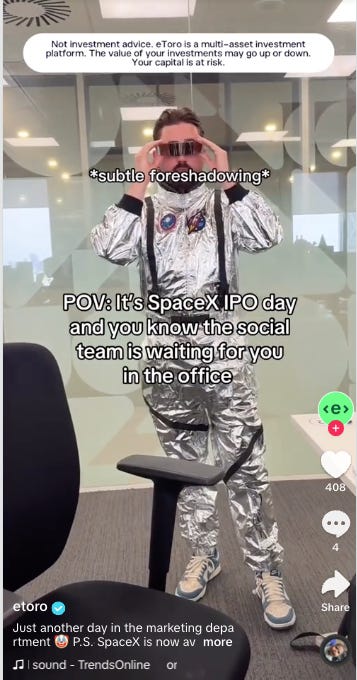
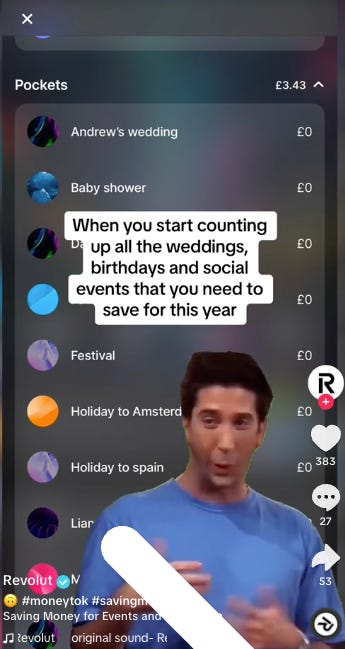
Brand language frequently describes the benefit. Social ideas tend to emerge from the behaviour surrounding it.
“Understand where your money goes” is useful. The way people actually behave around money is far more interesting.
Think about how people actually behave with money. You have a big weekend and avoid your banking app for a few days. You assume takeaways haven’t been too bad this month, then see the total. Same with coffees, Ubers and all those small purchases you barely think about at the time.
From there, the content might open with: “Guess how much I spent on Deliveroo last month.”
Now there is curiosity. There is a reveal coming. People can guess, compare it with their spending, and argue in the comments about whether £180 a month on takeaway is outrageous or completely reasonable.
The product has a natural place in the story.
This kind of thinking also lines up with what audiences say they value. Sprout’s 2025 Index found authenticity and relatability were the two traits consumers valued most from brands on social. Sprout Social
The more specific you get, the more relatable the idea becomes. “Saving money is hard” could apply to anyone. That horrible moment when you finally check your bank balance after an expensive weekend feels much more real.
The more recognisable the behaviour, the easier it becomes to build content around it.
3. Choose the right delivery vehicle

Once you know what needs communicating and have found the behaviour around it, the format becomes much easier to explore.
The idea could become a test, ranking, challenge, confession, experiment, comparison, tutorial, debate, mystery, creator collaboration, as well as recurring series.
The format can change depending on where it lives. Using TikTok, you could get a creator to reveal what they actually spent that month. Instagram might dig into the purchases people always underestimate, while Reddit could ask people which everyday expense quietly eats the biggest chunk of their salary.
The format should also make sense for the platform it lives on. The strategic message stays consistent while the experience changes.
This is increasingly important because people expect different things from brands on different platforms. Sprout’s 2026 Social Media Content Strategy Report surveyed more than 2,300 consumers across the US, UK and Australia and found that user expectations vary by network, with the report specifically recommending that brands adapt their presence to channel-specific behaviours. Sprout Social
4. Could another brand post this?

A good sense check is to imagine your competitor posting the exact same idea. Would it still work?
If you could swap the logos and barely notice the difference, there’s probably more work to do. The best ideas usually have something about the product, brand or audience baked into them.
You see the problem most clearly with trend content. A format takes off, twenty brands remake it and the feed quickly becomes a parade of companies delivering different versions of the same joke.
Consumers are increasingly sceptical of that behaviour. Sprout’s 2025 Index found that 33% think brands jumping on viral trends is embarrassing, while 27% say trend participation only feels effective within the first 24–48 hours. Their 2026 research also found that 43% of social users think brands fail to publish truly original content. Sprout Social
A stronger idea usually relies on something specific to the product, audience or brand.
The strongest ideas usually come from something only your brand can credibly play with.
A lightweight shoe can turn its weight into the joke.
A seasoning brand can put bland meals on trial.
A cashback brand can expose how much money people have unknowingly left behind.
The product gives the content its reason to exist. Take the brand away and part of the idea should disappear with it.
One message can become many social ideas
A simple way to practise this is to take one ordinary marketing message and force yourself to deliver it five different ways.
Imagine the message is: our meal kits make cooking quicker.
One route could be a race: can someone cook dinner before their usual takeaway would arrive?
Another could be an experiment where someone gets fifteen minutes between two meetings to make the meal.
You could turn it into a confession by asking people how often they order takeaway because they “have no time”, followed by a slightly uncomfortable look at their screen-time report.
It could become a recurring series called “Meals for people who have emotionally checked out by 6pm”, with every episode tackling another low-energy dinner situation.
Or you could give several creators the same meal kit and turn dinner into a completely unnecessary competition.
The product message has stayed the same throughout. Each version creates a different experience around it.
That is the value of separating the message from the idea. The message sets the boundary. The delivery system creates the possibilities.
Key takeaways
Your brand probably already has plenty to say. The creative opportunity is working out how those messages should travel.
Separate the message from the idea and get clear about the one thing people should take away. Look for the human behaviour around that message, because habits, frustrations, confessions and oddly specific experiences tend to create far more interesting social content than product messaging.
Most importantly, give the creative team enough space to build something around the message instead of turning the message itself into the content.
So the next time a brief says, “We need to communicate X,” keep X at the centre.
Then spend more time on the question that comes after it:
How would someone actually enjoy receiving it?
What I’m reading
Hacking the Human Mind: The behavioral science secrets behind 17 of the world’s best brands
The Choice Factory: 25 Behavioural Biases that Influence what We Buy
