
PR Needs Good Data More Than Ever

Trust is becoming PR’s most valuable currency
Back in 2024, I joined the digital PR industry as an assistant campaign creator, eager to learn as much as I could.
Since then, I’ve seen AI become a fixture of industry conferences, Google updates trigger collective groans across the office, and conversations about misinformation, fake experts and content quality become increasingly common. For someone relatively new to the industry, it feels like PR has spent the last two years trying to understand what trust looks like in a world where content has never been easier to create.
One thing that has stood out throughout all of those conversations is the role of data.
One of my first tasks was collecting third-party data for a campaign looking at popular film locations around the world. The dataset wasn’t particularly groundbreaking, but it taught me an important lesson early on. When a campaign is built on reliable evidence, there is something tangible underneath the story. Something that can be checked, challenged and, ultimately, trusted.
That feels particularly relevant today.
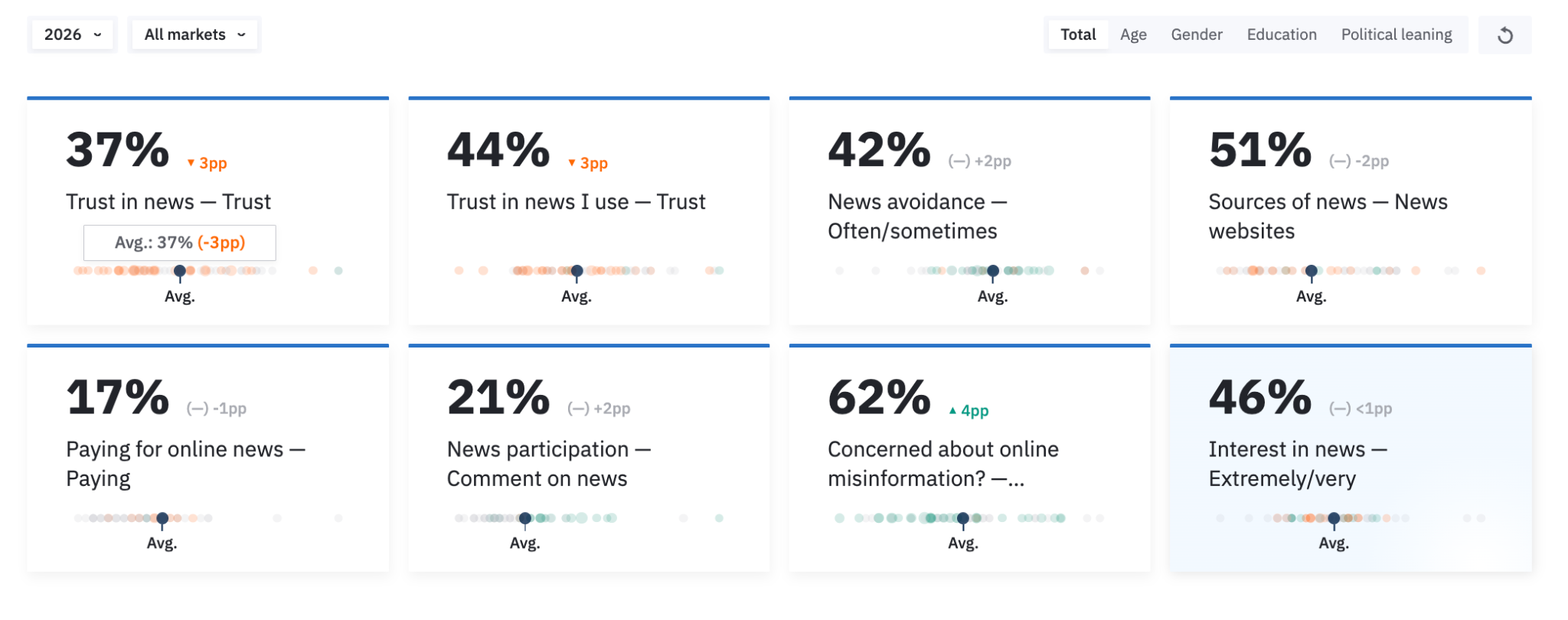
According to the Reuters Digital News Report 2026, trust in news has fallen to 37%, the lowest level recorded since the study began tracking it in 2015. Concerns about fake news have risen to 62%, while only 32% of people say they trust news they encounter through search engines. Reuters also found that 36% of search users click through to original news sources specifically to verify whether information is correct.
The Edelman Trust Barometer tells a similar story. Just 54% of respondents say they trust the media to do what’s right, while 81% believe accurate, non-exaggerated headlines would help rebuild trust.
These figures matter because they tell us something about the environment journalists, brands and PR professionals are operating in. Audiences are becoming more sceptical, information is being scrutinised more closely, and credibility is becoming harder to earn.
My view is that the industry hasn’t fully adapted to that shift yet.
We’ve spent years optimising for attention: finding hooks, reacting to trends and creating content that stands out. Those skills still matter, but I increasingly think they’re only part of the equation. As trust becomes harder to earn, the campaigns that perform best are likely to be the ones built on something more substantial than a good angle alone.
Whether it’s original research, first-party data, public records or FOI requests, robust evidence gives journalists and readers something tangible to evaluate for themselves rather than asking them to accept a claim at face value.
That’s why I think data-led PR has become so important. The question is whether we’re always giving research the time and attention it deserves.
The value of being able to prove something
One challenge I keep coming back to is that good research takes time.
In an ideal world, every campaign would have unlimited time to explore data sources, validate findings and pressure-test methodologies. The reality, of course, is that PR often operates at speed. Teams are reacting to trends, working to deadlines and trying to identify opportunities while they’re still relevant.
That’s part of what makes the discipline exciting, but it also means there can be a constant balancing act between moving quickly and digging deeper.

As trust becomes harder to earn, I find myself wondering whether the value of that deeper research is increasing. Not because creativity matters less, but because evidence gives creative ideas a stronger footing to stand on.
A campaign can be interesting without being particularly credible. It can generate discussion without providing much evidence. At a time where audiences are becoming more sceptical and journalists are spending more time validating information, I think that distinction matters more than it once did.
When a journalist decides whether to run a story, they’re deciding whether they trust the information enough to put their name to it. Increasingly, readers are making similar judgements. They want to know where a claim came from, how it was researched and whether it stands up to scrutiny.
If trust is becoming harder to earn, then evidence becomes more important. If evidence becomes more important, I think the industry needs to be careful not to treat research as something that happens after the idea has already been decided.
The campaigns that succeed over the next few years will still need creativity. They’ll still need strong storytelling, but I suspect they’ll also need stronger foundations than we’ve traditionally given credit for.
Journalists are already adapting
One of the most interesting sessions I attended at Digital PR Summit this year was Faces of Fakery, delivered by journalist Rob Waugh and PRCA CEO Sarah Waddington.
The talk explored what happens when credibility becomes harder to assess online. While fake experts have existed for years, Rob and Sarah argued that AI, increased competition for attention and the sheer volume of content being produced have made the problem much more difficult to navigate. Journalists are increasingly having to contend with fake experts, fake publications and online profiles that appear credible at first glance.
Like many people in the room, I wasn’t particularly surprised to hear about fake experts. Stories exposing them have become a fairly regular feature of industry conversations. What I found more interesting was hearing how journalists are adapting in response, and the role PR has to play in making credibility easier to establish.

Rather than taking information at face value, many reporters are building verification into their process. They are checking LinkedIn profiles, reviewing author pages and looking for signals that a spokesperson is who they claim to be, or if they are even a real person at all. The burden of proof is increasing because the cost of getting it wrong feels higher than ever.
That shift feels significant because it doesn’t stop with people. If journalists are spending more time validating sources, it stands to reason that they’re also spending more time validating the claims those sources are making.
This is where well-thought-out data can make a real difference.
A statistic backed by a transparent methodology is easier to trust than a vague claim. An FOI request provides something tangible that can be checked. First-party data gives journalists a clearer route back to the source of a story. None of these things guarantee coverage, but they do reduce uncertainty.
One of the key takeaways from the session was that trust has to be demonstrated. For PR professionals, that applies just as much to the information we provide as it does to the people providing it.
Data alone isn’t the answer. We are still storytellers at heart.
At this point, it would be easy to conclude that the answer is simply more data. More surveys, more statistics, more reports.
But one of the most useful reminders I heard at Digital PR Summit came from George Sinnott’s session, Where Data Meets Storytelling.

George argued that data is ultimately neutral. A dataset doesn’t arrive with a headline attached to it, nor does it automatically reveal why a finding matters. It can show a trend, highlight a pattern or uncover an interesting insight, but it still needs somebody to interpret it and explain its significance.
That distinction is important because good data alone doesn’t necessarily create a good campaign.
Some of the least compelling campaigns are packed with statistics but struggle to answer a simple question: why should anyone care? Equally, some of the weakest stories rely heavily on narrative without having enough evidence to support the claims they’re making.
The campaigns that tend to resonate sit somewhere between the two. They use data to uncover something interesting, but they don’t stop there. They provide context, explain the significance of a finding and connect it to something people recognise from their own lives, industries or experiences.
In many ways, this is where PR creates value. The role isn’t simply to collect data or present facts. It’s to take something that is true and meaningful, then communicate it in a way that feels relevant.
That’s why I don’t think the future of PR is data instead of storytelling. If anything, the growing importance of evidence makes storytelling even more valuable. As trust becomes harder to earn, the campaigns that stand out will be those that combine credible evidence with a compelling narrative.
After all, journalists don’t publish spreadsheets. They publish stories. Data might provide the foundation, but it’s interpretation that turns a finding into something worth talking about.
What this means for PR teams
If trust is becoming harder to earn, then I think there are a few implications for how we approach campaigns.
First, research needs to be brought into the process earlier. Too often, data is used to support an idea that already exists, rather than helping uncover the story in the first place. Some of the strongest campaigns I’ve worked on have started with a dataset, an FOI request or a question that needed answering, rather than a headline we wanted to write.
Second, we should probably broaden our definition of what counts as useful data. Surveys will always have a place, but first-party business data, search behaviour, public records and FOI requests can often provide richer and more original insights. In a media landscape saturated with opinions, originality increasingly comes from what you can uncover rather than what you can say.
Finally, credibility needs to be treated as a strategic asset. We spend a lot of time thinking about headlines, hooks and outreach strategies, but the strength of the evidence behind a campaign deserves the same level of attention. As journalists continue to verify information more rigorously, the quality of that evidence will only become more important.
None of this means creativity matters less. If anything, it means creativity has a stronger foundation to build on. The challenge for PR teams isn’t choosing between storytelling and evidence. It’s finding ways to combine both.
Things worth reading
Reuters 2026 Digital News Report - Reuters, 2026
Data has a reputation problem, and six chillies is here to solve it - Buzzstream, 2026
Ethical Storytelling in PR: Relevance, Reputation, Results - Virginia Hawkins, Screamingfrog, 2025
 |
|