

I love a gruelling hike, and I’ve researched far more hiking kit than I’ll ever admit to buying. My boots are also falling apart, so when I wanted to test how AI search handles a purchase decision, they felt like fair game.
I asked Google’s AI Mode: “What brand makes the best hiking boots?” It came back with five brands, the kind of list any of them would be pleased to see on an AI visibility dashboard. Then it asked me some follow-up questions about terrain, support, fit and budget. So I answered: “I’m a woman, I like ankle support, I’ll mostly be doing 10k walks on rainy days in the Lake District, and I want to spend under £150.”
Three of the original five brands instantly disappeared, a new one appeared out of thin air, and just two held their place.
Being visible in that first answer is the job good SEO should already be doing. The follow-up is where the buyer explains themselves, the recommendation gets rebuilt around their context, and a brand either fits or doesn’t. Most brands aren’t optimising for that moment, and most aren’t measuring it either. So why are so many still building their AI visibility tracking around the broad prompt?
Winning the first answer, but losing the sale
The hiking test: Where did everyone go?
The first answer was about what you’d expect: Salomon, Merrell, Lowa, Hoka, and Scarpa, with citations pulled from hiking review sites and “best boots” roundups. If you’re an established boot brand, this is where good SEO and a healthy presence across third-party publishers should already get you.
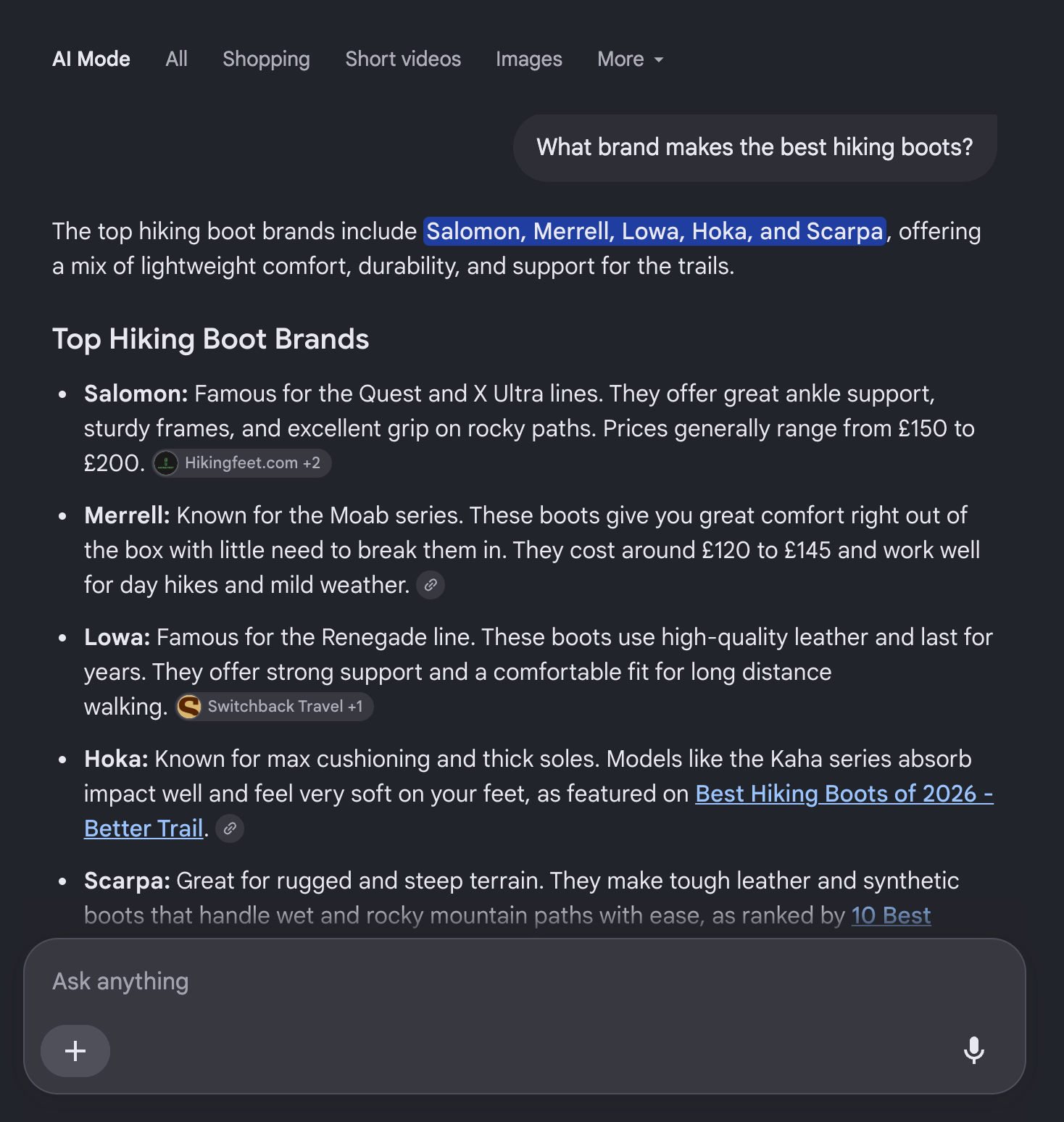
Source: Google AI Mode - “What brand makes the best hiking boots?”, September 2026 [Incognito mode]
The follow-up questions were the interesting part. Every one of them was about the person buying the boots, so the AI was essentially building a persona in real time.
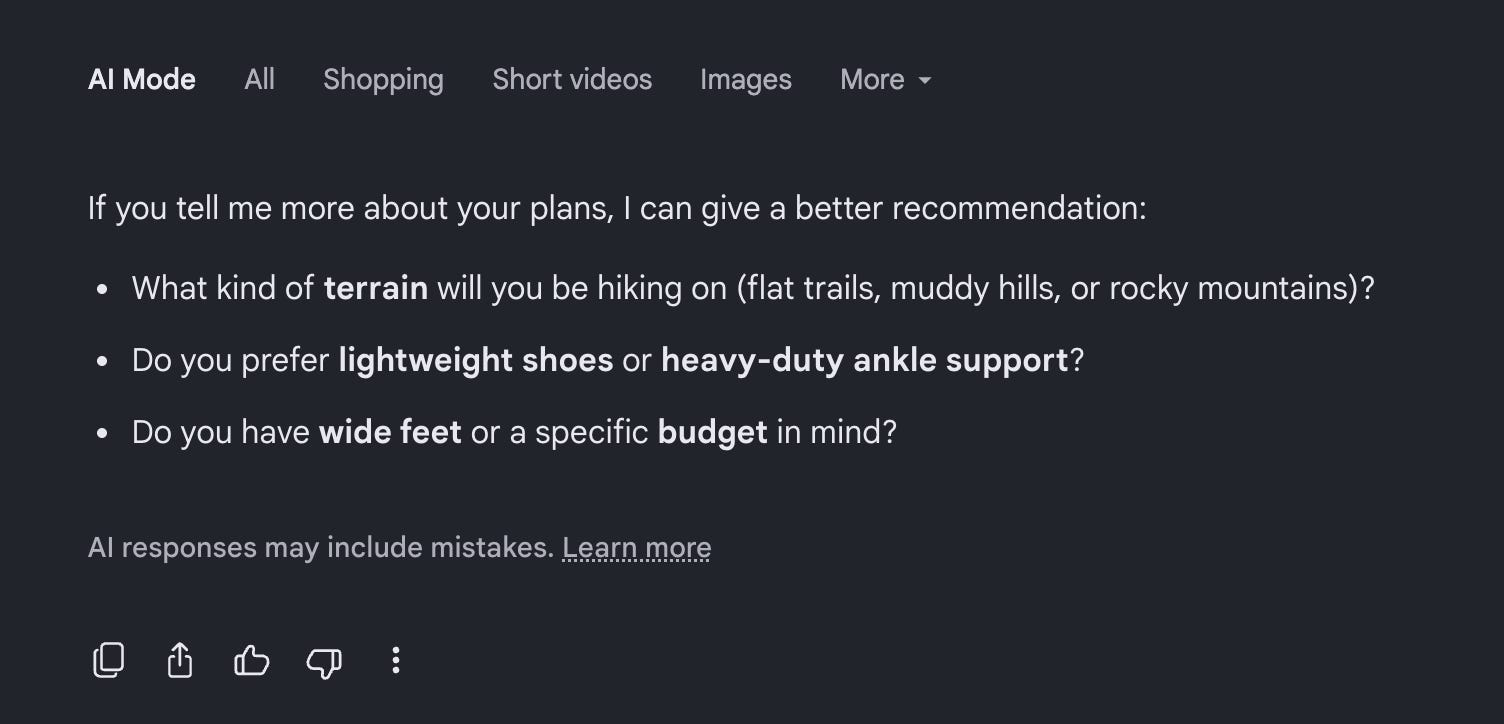
Source: Google AI Mode - follow-up questions, September 2026 [Incognito mode]
Once I’d shared some personal context, AI Mode rebuilt the list. The top three were now Berghaus, Salomon and Scarpa. Berghaus hadn’t featured in the first answer at all, and Merrell, Lowa and Hoka were nowhere to be seen.
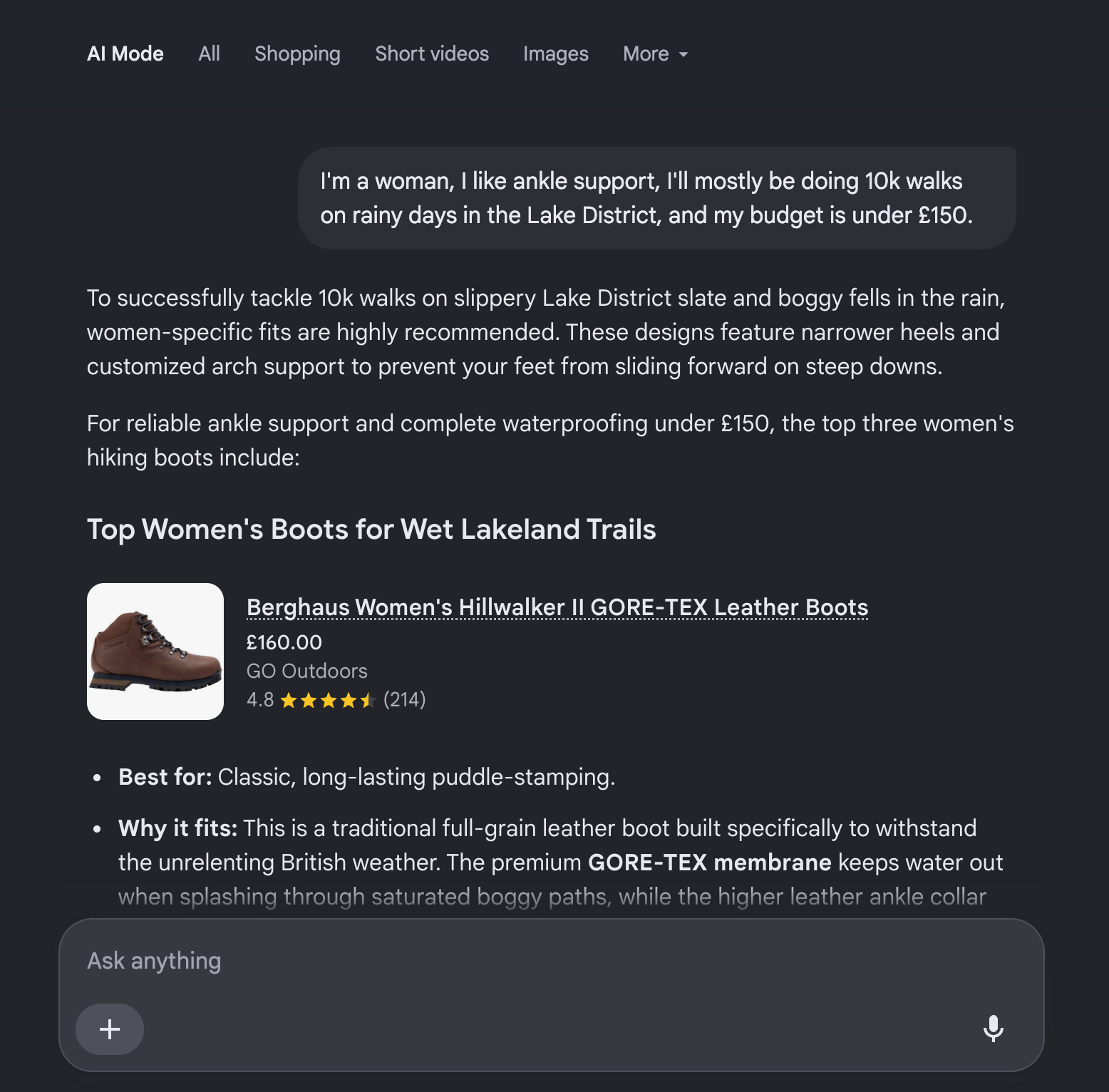
Source: Google AI Mode - follow-up response, September 2026 [Incognito mode]
When I asked what happened to them, its reasoning was specific:
Merrell’s Moab 3 Mid GTX was within budget, but judged a poor match for wet, slippery rock.
Lowa’s Renegade GTX Mid was excluded on price, despite the AI’s own shopping card listing it at £134.
Hoka’s high-stack cushioning was flagged as a stability risk on uneven, boggy ground.
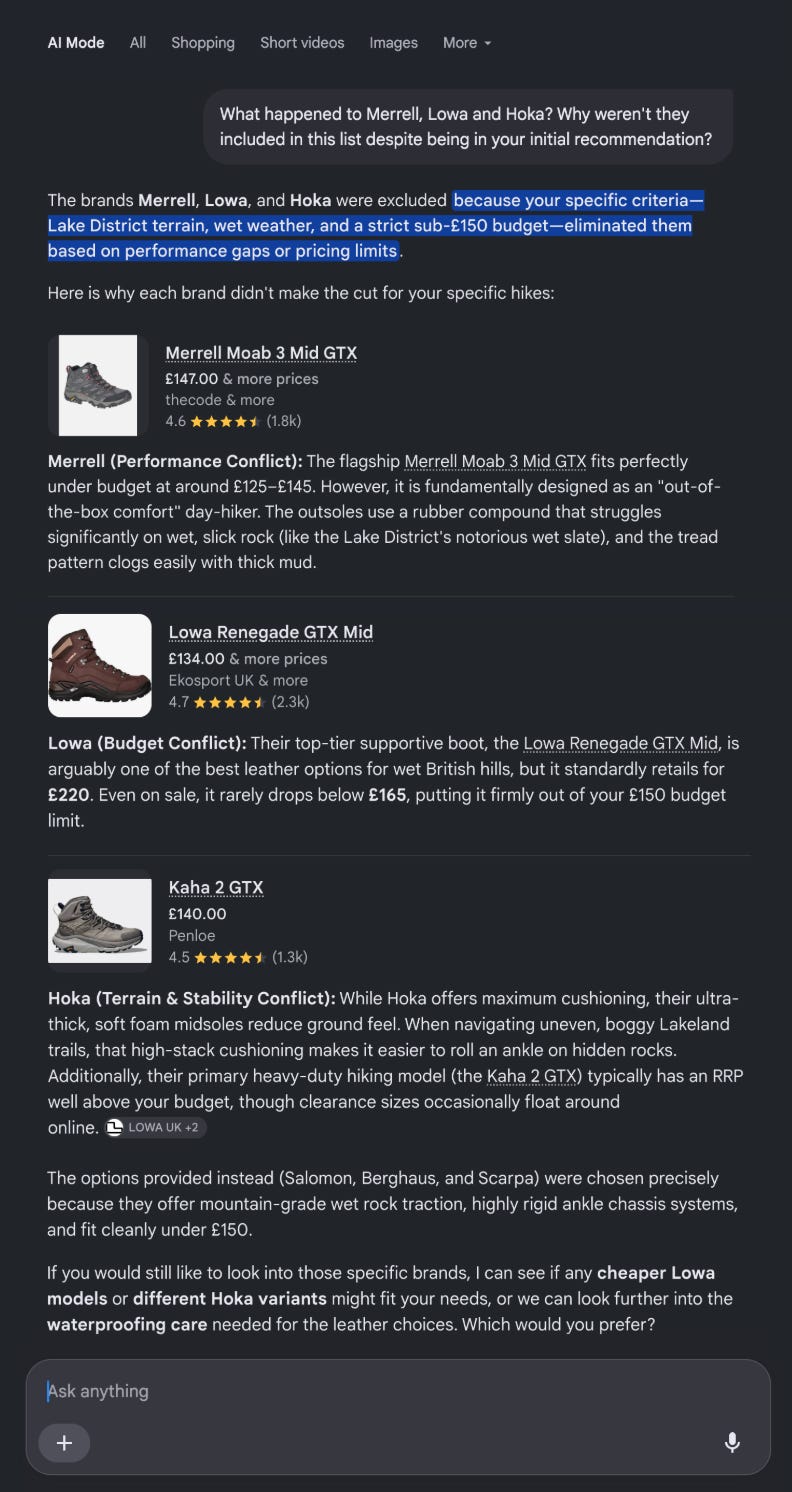
Source: Google AI Mode - rationale response, September 2026 [Incognito mode]
Slightly awkwardly for Lowa, the AI’s own shopping card listed the Renegade at £134 in the same answer. Whether that was a sale price the model didn’t weigh or a simple mix-up, the effect on the brand was the same: the AI’s understanding of your product detail decides whether you make the cut, and it doesn’t always get it right.
Look at the three reasons together: traction, price, and stability. and each only came up because I shared my personal context. Your buyers will do the same - the ability to ask hyper-personalised questions and get hyper-personalised answers back is the biggest change AI has brought to search, and a prompt bank built around broad queries only captures what’s recommended to someone who’s not told AI anything about themselves - that buyer is a ghost. You’ll be logging wins with no idea why conversions aren’t following.
This is one conversation, not a study, and if you run it again the list may well shift - that’s kind of the point. AI recommendations are rebuilt around each person who asks, so tracking one broad prompt measures a version of the conversation that most buyers never have.
Why do so many prompt banks keep tracking the first question?
Mostly because of the data available when they’re built. Keyword research is mature and familiar, and prompt volume tools promise the same kind of familiarity and prioritisation for AI search, but those volume figures are modelled from panels, clickstream data and projections, and there’s no comprehensive way to capture the millions of prompt variations people are asking. Sort by ‘prompt volume’ and you’ll naturally land on broad, category-level prompts (or terms that appear in prompts), because that’s where the numbers look biggest, and where ghosts live.
My hiking test isn’t a one-off, either. When research firm Clovion studied how Claude, ChatGPT and Gemini recommend brands across a conversation, adding one ordinary buyer detail, as plain as “for a small team,” meant 62% of the brands in the first answer were gone by the second.
Your teams already know the follow-up
Personal context lives mostly with the teams who hear it every day, and rarely with the people building the prompt bank. No keyword tool can tell you what makes your buyers hesitate at the last minute, or what they call your product when nobody from marketing is listening.
When we run prompt workshops, we ask each function to do some homework beforehand:
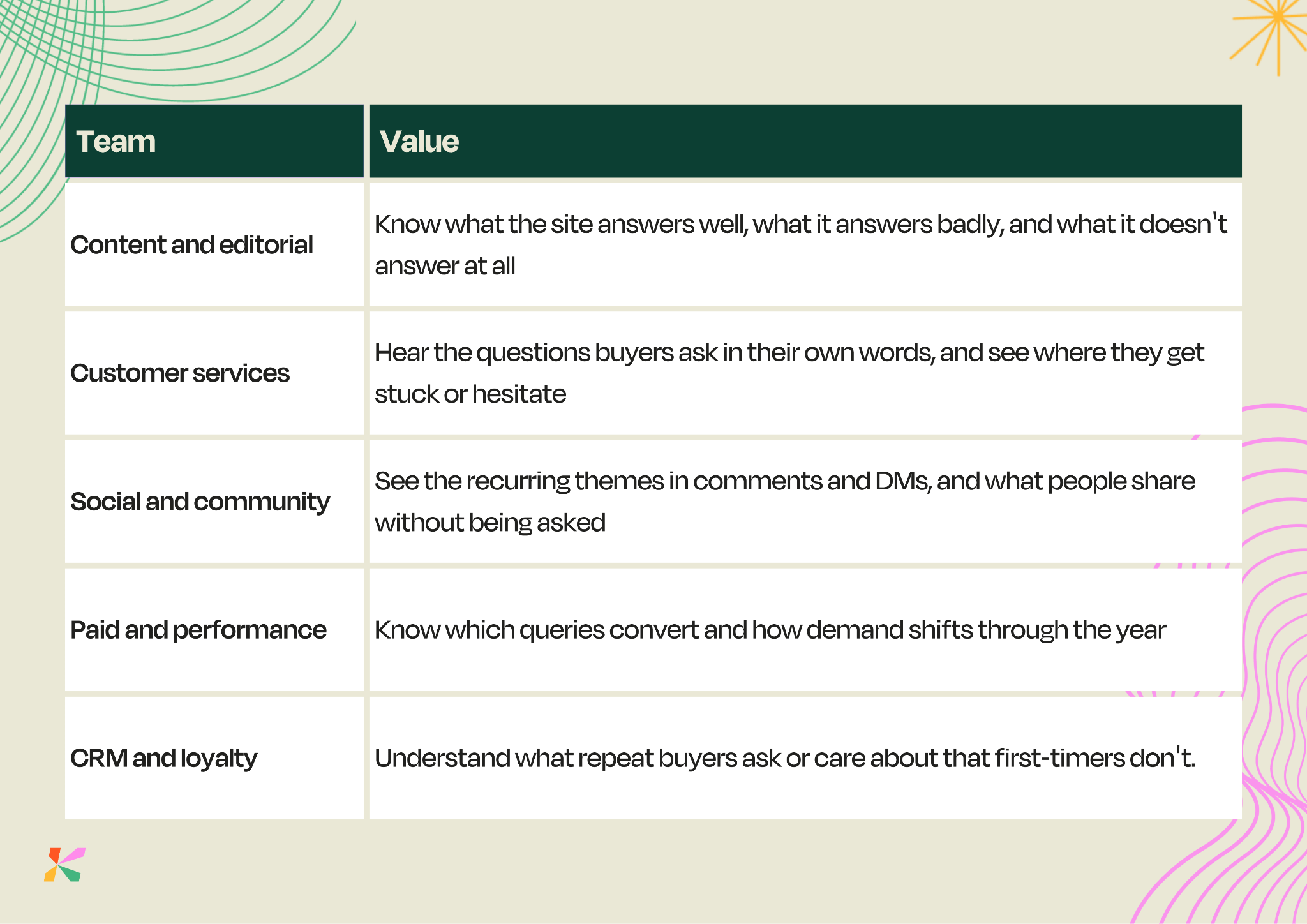
Customer services deserves an extra-special mention. People explain themselves to a customer service agent much like they talk to AI: in full sentences, with their personal context attached, and usually at the moment something is stopping them from buying. In our recent workshop with Disney, the questions landing on the contact centre pointed straight at gaps in on-site content. These are the same questions an AI answer engine will happily answer using competitors or social discourse if the brand’s own site doesn’t.
The trouble is that this knowledge is spread across five teams, five sets of tools and five reporting lines, and very little of it reaches the people writing a prompt bank. The workshop gets it into one room.
Inside the prompt workshop
A prompt workshop is essentially a data integrity exercise with juicier discussions, and crucially, each stage checks the prompt bank against something a keyword tool can’t see.
Commercial framing: Before anyone writes a prompt, we agree what the business needs the prompt bank to support, so the output stays tied to revenue rather than curiosity.
Functional signals: Each function sorts its homework into:
Enablers (what helps someone buy), e.g. ankle support
Questions (what they need answered before they’ll commit), e.g. how long do they last?
Blockers (what stops them), e.g. price point
There are no personas yet, just different perspectives on the same three buckets.
Persona alignment: In cross-channel groups, the room matches each signal to the persona it belongs to. For a hiking brand, that might be Doorstep Walkers heading to the local park or forest at the weekend, or Long-Haul Hikers on multi-day routes. Signals that fit no persona are worth keeping too, because they usually point to an audience nobody has planned for yet.
Prompt seed list: Each group then drafts at least 50 seed prompts across one persona’s journey, mixed across formats like comparison, validation and recommendation. The key distinction is between relevant prompts, which plenty of people might ask (”What are the best hiking boots for walking in the UK?”), and unique prompts, which carry one persona’s personal context (”What are the best women’s hiking boots with ankle support for wet 10k walks in the Lake District? My budget is £150.”). The first is just the opening question. The second is the follow-up, written down in advance - that’s where we lean in.
Same framework, different weightings
The structure stays the same for every brand, but the weightings change every time. A hiking brand whose buyers are mostly beginners might lean on early-stage validation prompts like “Do I actually need proper boots for 10k walks on flat ground?”, while a brand fighting half a dozen established names for the same buyer will weight comparison prompts far more heavily, because “X vs Y” is where it wins or loses.
From first draft prompt bank to benchmark measurement
A room full of experts produces a strong first draft, but it’s still a first draft. What happens next is a series of checks, each catching something the previous stage couldn’t:
Structure it: We tidy the seed prompts, remove duplicates, and map them against the agreed weightings, so any gaps in the journey or format mix are obvious straight away.
Seed it: The seed list feeds into our PersonaPrompt Engine, which builds out conversational prompts for each persona across intent types that are reviewed, amended and refined by our team of experts.
Enrich it: Our tool’s Reddit, YouTube and Trustpilot analyses flag insights from the customers who don’t talk to the brand directly, like multiple threads about boots that started leaking on day three of a long-distance route.
Sign it off: The full list goes back to the brand for QA and final amendments. Nothing is tracked until it’s greenlit, and then it becomes the benchmark.
What it unlocks
Every prompt is tied to a persona and a signal, so every gap comes with a reason attached. If AI visibility with Doorstep Walkers keeps dropping on waterproofing prompts, that’s a product page and content brief leaning into the signals and products they care about. If Long-Haul Hikers never see you in comparison prompts, that’s a job for digital PR and your review strategy. And because the teams who wrote the prompts are usually the ones who need to act on them, getting those recommendations over the line gets a lot easier.
Key Takeaways
Check whether your prompt bank measures the first question or the follow-up. If most of your tracked prompts could be typed into Google as keywords, you’re measuring visibility for ghosts.
Get the teams who hear your buyers into one room before writing any prompts. Each holds part of the personal context that decides the follow-up.
Treat your prompt bank as signed-off data. Weight it for your category and competitors, check it against the outside world, and lock it before you measure.
Ghosts don’t need to buy hiking boots. Track the type of humans who do.
Things worth reading
7 hard truths about measuring AI visibility and GEO performance - Search Engine Land, 2026
A clear-eyed look at what AI visibility tools can and can’t tell you, including why prompt volume charts should be read as educated guesses rather than absolute truths.
62% Of AI Brand Recommendations Vanish After One Buyer Question - Search Engine Journal, 2026
A multi-turn study of how AI assistants rebuild their recommendations once a buyer adds detail. The coverage is candid about the study’s methodology, including a layout error that dropped a zero from some figures, which the research firm later corrected.
The Silo Effect - Gillian Tett, 2015
The FT journalist’s book on how organisations split knowledge into separate teams and systems, and what happens when nobody connects the pieces. It’s a useful lens for why customer insight so rarely reaches search teams.
